Skip to content
SUBSCRIBE
  • Technology
    10-Powerful-Ways-Artificial-IntelligenceIs -Transforming-the-Future
    Artificial Intelligence Data Security Security Technology Technology 2025
    10 Powerful Ways Artificial Intelligence Is Transforming the Future
    December 10, 2025
    prathmesh kupade
    No posts found
    download - 2025-07-11T145023
    Technology
    Research highlights an emerging trend: Organizations are shifting to private cloud to optimize workloads
    download (62)
    Technology
    IDC MarketScape: Worldwide Managed Detection and Response 2024 Vendor Assessment
    A Portfolio of Intelligent Business Applications That Transform Your Business
    Technology
    The ABC of Microsoft Dynamics 365: A Portfolio of Intelligent Business Applications That Transform Your Business
    No posts found
    View All
  • HRTech
    AshleyAdams
    Hrtech
    The metrics every in-house team should track
    January 29, 2026
    prathmesh kupade
    No posts found
    Navigating the Paths of Risk: The State of Exposure Management in 2024
    Hrtech
    Navigating the Paths of Risk: The State of Exposure Management in 2024
    Uncover Hidden Savings and Boost the Bottom line in F&B Manufacturing
    Hrtech
    Uncover Hidden Savings and Boost the Bottom line in F&B Manufacturing
    6 Workloads Optimized on Dell APEX Cloud Platform for Microsoft Azure
    Hrtech
    6 Workloads Optimized on Dell APEX Cloud Platform for Microsoft Azure
    No posts found
    View All
  • Finance
    COMPREHENSIVE GUIDE TO SECURITY OPERATIONS
    Finance
    Comprehensive Guide to Security Operations
    January 21, 2026
    vaishnavi chavan
    No posts found
    download 85
    Finance
    Wie sich der ROI mit Slack verdreifachen lsst
    download 56
    Finance
    Protecting Your C-Store Against the Hidden Costs of Compliance Violations
    State of Ecommerce in India
    Finance
    State of Ecommerce in India
    No posts found
    View All
  • Marketing
    6 Tips For Better Digital Learning In The Workplace
    Marketing
    6 Tips For Better Digital Learning In The Workplace
    January 23, 2026
    prathmesh kupade
    No posts found
    Warum aufstrebende Mittelständler auf Workday setzen
    Marketing
    Wachsen Sie mit Workday in Ihrem mittelstndischen Unternehmen!
    Human Risk Review 2023 – ENG
    Marketing
    Human Risk Review 2023 – ENG
    Screenshot-2026-01-16-195020
    Marketing
    The Operational Efficiency of Hybrid Cloud Deployments and Management
    No posts found
    View All
  • Resources
    • Web Development
    • Technology 2025
    • Supply Chain
    • Storage
    • Security
    • Networking And Communication
    • MSP
    • Library
    • IT Security
    • IT Management
    • IT Infrastructure
    • IOT
    • Global Trade
    • Stock Market
    • Insurances
    • Banking
    • Finance 2025
    • ERP
    • Ecommerce
    • Ebook
    • Digital Advertising
    • Data Security
    • Data Management
    • Content Marketing
    • Cloud Migration
    • Cloud Computing
    • Big Data
    • B2B Marketing
    • Audit And Compliance
    • Artificial Intelligence
    • Application Development
    • API
    • Analytics
    • Abm Marketing
  • Contact
  • About
    • Privacy Policy
    • Terms of Use
    • Cookies Notice
  • work-with-us
    • Advertise With-Us
  • Technology
    The fundamentals of establishing digital trust
    Technology
    The fundamentals of establishing digital trust
    January 28, 2026
    prathmesh kupade
    No posts found
    8 Things to Know When Switching from Windows to Linux
    Technology
    8 Things to Know When Switching from Windows to Linux
    download (14)
    Technology
    Start your AI journey without lock-in
    download 13
    Technology
    The Self-Service Reality
    No posts found
    View All
  • HRTech
    Reduce Licensing Costs and Modernize Enterprise Workloads
    Hrtech
    Reduce Licensing Costs and Modernize Enterprise Workloads
    January 22, 2026
    prathmesh kupade
    No posts found
    Top 5 Critical Capabilities of a Detection and Response Platform
    Hrtech
    Top 5 Critical Capabilities of a Detection and Response Platform
    Parents and Student Portal – Stay Connected to Your Educational Journey
    Hrtech
    Parents and Student Portal – Stay Connected to Your Educational Journey
    download 48
    Hrtech
    Network Monitoring Software - Reviews Tips and Advice from Real Users
    No posts found
    View All
  • Finance
    Introducing AI company-wide
    Finance
    Introducing AI company-wide
    January 28, 2026
    prathmesh kupade
    No posts found
    download-2 (1)
    Finance
    Complex Tax Calculations With a Single Source of Truth: Increase Agility With Longview Tax and Reduce Risk
    download 56
    Finance
    Protecting Your C-Store Against the Hidden Costs of Compliance Violations
    5 Key Elements of a Data-driven Culture
    Finance
    5 Key Elements of a Data-driven Culture
    No posts found
    View All
  • Marketing
    Best AIOps Solutions | What are AIOps?
    Marketing
    Best AIOps Solutions | What are AIOps?
    January 30, 2026
    prathmesh kupade
    No posts found
    How-B2B-Tech-Publishers-Can-Use-Google-Ads-to-Boost-Lead-Quality
    Analytics
    How B2B Tech Publishers Can Use Google Ads to Boost Lead Quality
    Screenshot-2026-01-16-195020
    Marketing
    The Operational Efficiency of Hybrid Cloud Deployments and Management
    Understanding the breadth and depth of modern data protection
    Marketing
    Understanding the breadth and depth of modern data protection
    No posts found
    View All
  • Resources
    • Web Development
    • Technology 2025
    • Supply Chain
    • Storage
    • Security
    • Networking And Communication
    • MSP
    • Library
    • IT Security
    • IT Management
    • IT Infrastructure
    • IOT
    • Global Trade
    • Stock Market
    • Insurances
    • Banking
    • Finance 2025
    • ERP
    • Ecommerce
    • Ebook
    • Digital Advertising
    • Data Security
    • Data Management
    • Content Marketing
    • Cloud Migration
    • Cloud Computing
    • Big Data
    • B2B Marketing
    • Audit And Compliance
    • Artificial Intelligence
    • Application Development
    • API
    • Analytics
    • Abm Marketing
  • Contact
  • About
    • Privacy Policy
    • Terms of Use
    • Cookies Notice
  • work-with-us
    • Advertise With-Us
Home » Supply Chain
Category:

Supply Chain

How to Build an Efficient Supply Chain System Using AI and Automation
Supply Chain

How to Build an Efficient Supply Chain System Using AI and Automation

by ailcia sierra April 23, 2026
written by ailcia sierra

In Present Day business environments, operations are becoming increasingly complicated. The goal of any company is to produce goods efficiently, lower expenses, and keep high standards of customer satisfaction. Nevertheless, traditional approaches to management are not able to meet new requirements. Thus, the application of intelligent solutions and automation processes significantly contribute to the evolution of the supply chain.

Intelligent systems stimulate companies to change their tactics because they can process vast amounts of information, anticipate customer demand, and facilitate better decisions. Moreover, automation processes decrease manual labor and ensure improved efficiency. Consequently, the evolution of the supply chain through the application of innovative technologies becomes apparent.

A management strategy is not just about transferring goods from point A to point B. It is crucial to carefully consider all the aspects of the process, such as planning, procurement, manufacturing, and delivery. Modern technological solutions allow for improving every step.

Understanding the System

An operational system in modern times encompasses all the actions taken in procurement, manufacturing, warehousing, and distribution. All these actions must be coordinated so that tasks will be performed effectively. The result of this alignment will be improved productivity and results.

The operational structure ensures efficient coordination and visibility so that the organization can manage its performance better and be able to react to any changes that occur. This ability helps achieve better results and meets customers’ requirements.

Today, there are digital technologies that can improve this process even further through insights, automation, and data-driven decision-making.

Core Components

  • Procurement and Sourcing
  • Manufacturing Processes
  • Inventory Management
  • Transportation
  • Distribution

Traditional vs Smart Systems

FeatureTraditional ApproachSmart Approach
Decision MakingManualData-driven
SpeedSlowerFaster
AccuracyModerateHigh
FlexibilityLimitedHigh
Understanding the System

The Role of Intelligent Technologies

Smart technologies have really changed how companies do business. They help companies look at a lot of data and find patterns. This means companies can make decisions and get more work done.

One of the things about smart technologies is that they can predict what will happen. Companies can see what people will want and plan for it. This reduces the chance of things going wrong. Makes business run more smoothly.

Main Advantages

  • decision-making
  • Real-time information
  • Forecasting abilities
  • operating costs
  • Higher efficiency

Smart technologies are very useful for companies. They help companies make decisions and work well. Intelligent technologies like these are very important, for business. The role of technologies is to make business easier and better. Intelligent technologies do this by helping companies use data to make decisions.

Optimization Techniques for the Supply Chain

The supply chain optimization techniques aim at enhancing efficiency and minimizing costs. The techniques comprise analysis and finding areas of improvement. Companies employ technology to increase efficiency.

The optimization techniques include improved inventory management and efficient delivery process. They also entail minimizing wastage and maximizing resource utilization. The effects of these techniques are increased efficiency.

Adoption of AI and automation ensures efficient optimization. The techniques make organizations capable of responding to changes and maintaining efficiency.

Techniques for Optimization

  • Process automation
  • Data-driven decision making
  • Inventory optimization
  • Route optimization
  • Supplier management

Supply Chain Optimization Methods

MethodPurposeBenefit
AutomationReduce manual workEfficiency
AnalyticsData insightsBetter decisions
Inventory ControlManage stockCost reduction
Logistics PlanningImprove deliveryFaster service

AI in Demand Forecasting

It is important to forecast demand in the supply chain process since it enables organizations to plan and make decisions. This will allow the organization to anticipate demand for its products.

AI in demand forecasting can enhance accuracy since it uses data from the past together with other variables like seasonality and consumer behavior to predict demand effectively.

Benefits of Demand Forecasting

  • Inventory planning
  • Minimizing wastage
  • Customer satisfaction
  • Efficiency
  • Costs saving

Automation in Supply Chain

Automation is one of the essential elements of increasing the effectiveness of the supply chain. With its help, manual procedures can be minimized, and operations will become faster. In other words, productivity will increase.

Automation is utilized in warehouse management and order processing. Such an approach guarantees greater precision and fewer mistakes. As a result, performance will be enhanced.

The synergy between automation and artificial intelligence enables creating an extremely effective system that will handle all the complex tasks easily.

Advantages of Automation

  • Increased speed
  • Accuracy
  • Cost reduction
  • Efficiency
  • Scalability

Significance of Real-Time Data

Real-time data is really important for supply chains that we have today. We can get information away, from real-time data and this helps us make good decisions.

Companies can use real-time data to keep track of deliveries and manage the things they have in stock. This makes things work better and reduces the chances of something going wrong.

Factors

  • We need to make decisions right away with real-time data
  • We can see everything that is happening with real-time data
  • Real-time data helps us work more efficiently
  • Real-time data reduces the risks that companies face
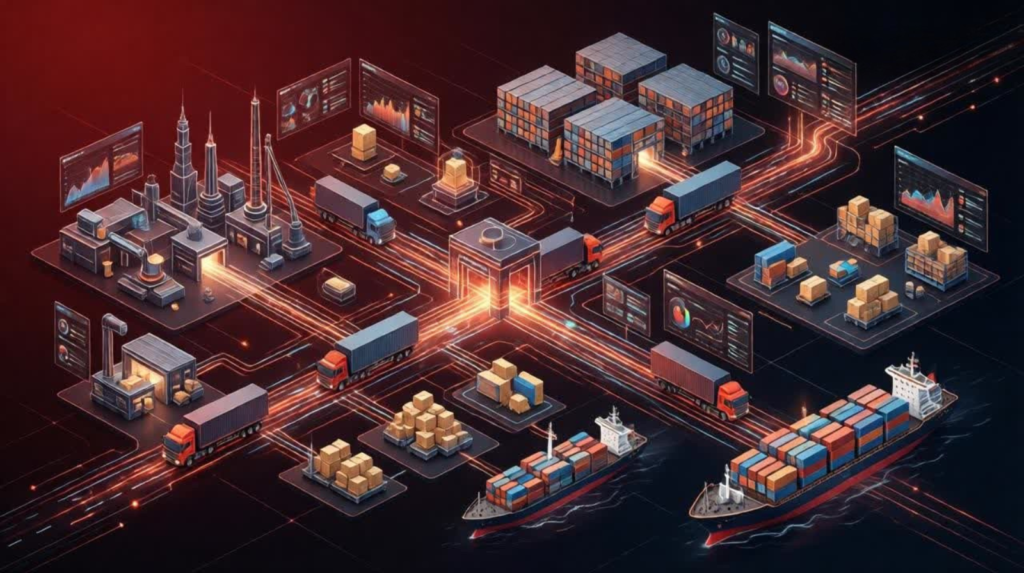
Logistics in Supply Chain Management

Logistics in Supply Chain Management

Logistics forms an important component of supply chain management systems. It refers to transport and delivery of products. Effective logistics guarantees timely delivery of the products.

The use of AI optimizes transport routes, thus reducing costs and improving efficiency. This also boosts customer satisfaction.

Important aspects

  • Effective transportation
  • Reducing costs
  • Timely delivery
  • Improved planning

Logistics Optimization

AspectBenefit
Route PlanningFaster delivery
Cost ControlLower expenses
TrackingBetter visibility

Risk Management in Supply Chain

Managing risks is crucial for building a supply chain.

Today businesses face uncertainties like delays and supplier problems. These risks can stop operations. Make customers unhappy if not handled well. Companies must find risks early. Have plans ready.

Key Points

  • Identify risks on
  • Have plans, in place
  • Regularly check operations
  • Use data to make decisions
  • Make supply chains more flexible

Inventory Management

Effective inventory management is responsible for maintaining optimal stock levels. This prevents any shortage and surplus problems. This enhances efficiency.

AI technology assists in keeping real-time records of inventory. This facilitates better planning and management. Additionally, costs are reduced.

Important Points

  • Stock management
  • Cost savings
  • Planning
  • Efficiency

The Digital Transformation of the Supply Chain

There have been numerous transformations in the way business entities manage their supply chain operations. These transformations involve the use of technology to facilitate smoothness and efficiency in the activities carried out within such a business entity. The company is shifting from the activity-based approach and adopting the digital platform, which allows them to be in control and provide an overview of the activities taking place.

This transformation has become vital for organizations that wish to remain competitive within their industries.

Points to Consider

  • Utilize digital tools in managing operations
  • Receive real-time updates regarding operations
  • Make sound decisions by making use of the necessary information
  • Efficient operation
  • Improved coordination within the supply chain

Future of AI in Supply Chain

The future of AI in supply chain management is really looking good. New things are coming out all the time. These new things will make supply chain management work better.

AI in supply chain management will help people make choices and will automate a lot of tasks. This is going to change the way supply chain management works. Companies need to change with the times to stay ahead of the game.

Key Points

  • Advanced analytics for AI in supply chain management
  • Increased automation in AI in supply chain management
  • Better forecasting with the help of AI in supply chain management
  • Improved efficiency in AI, in supply chain management

Future Trends

TrendImpact
AI GrowthSmarter systems
AutomationEfficiency
Data AnalyticsBetter insights

Supply Chain Problems and Solutions

There are a lot of issues that supply chains have to deal with these days. Supply chains have to deal with delays, rising costs and changes in demand. It is really important to find ways to solve these supply chain problems.

New technology gives us ways to solve these supply chain problems. Artificial intelligence helps us predict problems and plan for the future. Automation reduces mistakes. Helps us get more work done.

Companies need to be ready to think. That means they have to keep an eye on things and make improvements all the time.
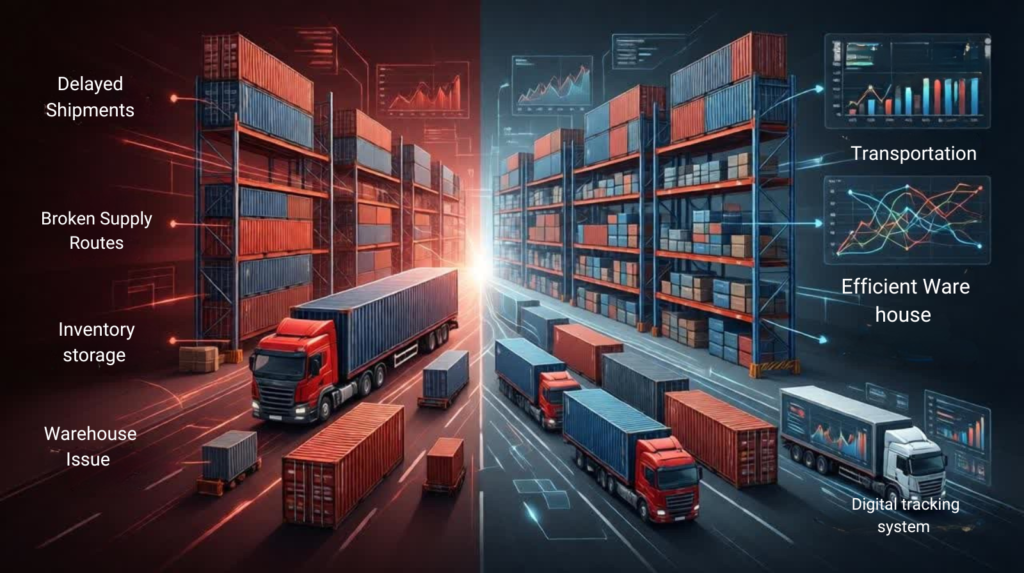
Supply Chain Problems and Solutions

Problems Faced

  • Uncertainty of demand for products
  • operational expenses
  • Disruptions in the supply chain process
  • Visibility issues in the supply chain
  • Inefficiency, in the supply chain

Challenges and Solutions

ChallengeImpactSolution
Demand FluctuationStock issuesAI forecasting
High CostsReduced profitOptimization
DelaysCustomer dissatisfactionAutomation

Conclusion

In the world we live in today businesses need more than the basics to stay ahead. They need systems that’re smart and can change and get better over time. If businesses only use the ways of doing things it can slow them down.. If they use new and modern ways it can make things run more smoothly and be more efficient.

Using Artificial Intelligence and automation can make a difference. It means people do not have to do much work by hand and it helps get things right. It also helps teams make decisions faster. This saves businesses time and money. It also makes customers happier. When everything works together the results are more consistent and reliable.

At the end of the day it is not about using technology. It is about using Artificial Intelligence and automation in the right way. Businesses that always try to get better and are open, to change will always be one step ahead. With the way of thinking and the right tools building a system that works well and can grow with the business becomes much easier. Businesses that use Artificial Intelligence and automation will find it easier to build a system that’s efficient and scalable.

FAQS

1. Define the concept of the supply chain system.

The supply chain system refers to the whole process of product movement from the supplier to the consumer. The processes include sourcing, manufacturing, warehousing, and distribution.

2. Explain how AI can be useful in managing the supply chain.

AI can be useful because it will analyze available information, make predictions about customer demand, and improve decision-making for companies that implement AI in their supply chain management system.

3. What part does automation take in the supply chain systems?

Automation takes care of tasks that require a lot of time for employees. These tasks include order entry and updating stock.

4. How can businesses make their supply chain work better?

Businesses can make their supply chain work better by using tools that look at the numbers making processes simpler reducing the time things get delayed and using technology like Artificial Intelligence and automation.

5. What are the good things about using Artificial Intelligence in supply chain operations?

The good things, about using Artificial Intelligence in supply chain operations are that it helps businesses predict what will happen better it makes things more accurate it saves businesses money it helps them make decisions faster. It makes the whole supply chain work better.

6. What are some common problems that businesses have with their supply chain?

Some common problems that businesses have with their supply chain are that people want things at different times things get delayed it costs a lot of money businesses do not know what is going on and the processes are not very good.

April 23, 2026 0 comment
0 FacebookTwitterPinterestEmail
The Rise of LLM Supply Chain Attacks in AI Search Ecosystems
Artificial IntelligenceSupply ChainTechnology

The Rise of LLM Supply Chain Attacks in AI Search Ecosystems

by Saurav Dhawale March 28, 2026
written by Saurav Dhawale

Search is being transformed quickly by artificial intelligence. Rather than generalized search engines that rely on keywords, search engines currently use AI systems that rely on large language models to provide direct answers, summaries, and recommendations to users. LLMs are being used in productivity tools, enterprise processes, and search platforms such as OpenAI, Google, and Microsoft.

Nonetheless, this change brings about a different form of risk, namely LLM supply chain attacks. These attacks target the inputs and dependencies on which AI models depend, as opposed to traditional cyberattacks which focus on systems.

Since AI systems are driven by data and external sources, it is possible to manipulate these sources and silently affect system outputs.

Gartner states that by 2026, organizations that attempt to deploy generative AI without sound governance will encounter more risk associated with data poisoning, model abuse, and vulnerabilities in supply chains.

This blog shows the mechanics of LLM supply chain attacks, the reasons they are increasing, real-life cases, and ways of defending businesses within AI ecosystems.

What Are LLM Supply Chain Attacks?

LLM supply chain attacks are attacks conducted by attackers who tamper with any of the elements related to the process of building, training, or even utilizing an AI model.

These components include:

  • Training datasets
  • Fine-tuning data
  • Embedding models
  • APIs and plugins
  • Retrieval systems (RAG pipelines)
  • Third-party integrations

Instead of attacking the AI model directly, attackers manipulate the ecosystem around it.

Why AI Search Ecosystems Are Highly Vulnerable

AI search engines are highly dependent on various external relationships. This creates a larger attack surface compared to conventional search engines.

Key Vulnerability Factors

1. Dependence on External Data

LLMs use vast datasets from the internet, which may contain malicious or biased content.

2. Retrieval-Augmented Generation (RAG)

Contemporary AI search engines retrieve real-time information from external sources. If such sources are compromised, outputs become unreliable.

3. Plugin and API Ecosystems

AI tools integrate with third-party services, increasing exposure to vulnerabilities.

4. Lack of Transparency

LLMs operate as black boxes, making it difficult to trace where compromised outputs originate.

According to OWASP, LLM-specific risks such as prompt injection and data poisoning are among the top emerging AI security threats.

Types of LLM Supply Chain Attacks

1. Data Poisoning Attacks

Attackers inject malicious or misleading data into training datasets.

Impact:

  • Biased outputs
  • Misinformation
  • Manipulated recommendations

Example: If financial datasets are poisoned, AI could generate incorrect investment advice.

2. Prompt Injection Attacks

Attackers craft hidden instructions within input data to manipulate AI responses.

Impact:

  • Unauthorized data access
  • Output manipulation
  • Security bypass

This is one of the most discussed threats in generative AI security.

3. Malicious Plugin Exploits

AI systems often rely on plugins to access tools and services.

Impact:

  • Data exfiltration
  • Unauthorized actions
  • System compromise

4. Model Dependency Attacks

Organizations often use pre-trained models from external providers.

Impact:

  • Backdoors in models
  • Hidden vulnerabilities
  • Compromised outputs

5. Retrieval System Manipulation (RAG Attacks)

Attackers manipulate external content sources used by AI.

Impact:

  • False answers
  • SEO manipulation
  • Brand misinformation

Real-World Signals and Evidence

While LLM supply chain attacks are still emerging, several real-world indicators highlight the risk:

  • Stanford University research has shown how LLM outputs can be manipulated through adversarial inputs.
  • MIT studies highlight vulnerabilities in AI systems related to data integrity and model trust.
  • IBM reports that AI security is becoming a top enterprise concern due to increased adoption of generative AI tools.

Additionally, the OWASP Top 10 for LLM Applications identifies risks such as:

  • Prompt injection
  • Data leakage
  • Supply chain vulnerabilities
  • Insecure plugins

How LLM Supply Chain Attacks Work (Step-by-Step)

  1. Identify Target System
    Attackers analyze AI systems and their dependencies.
  2. Exploit Weak Link
    They target datasets, APIs, or plugins.
  3. Inject Malicious Content
    This could be hidden instructions, biased data, or manipulated information.
  4. Trigger AI Response
    When users query the system, the AI unknowingly processes compromised inputs.
  5. Deliver Manipulated Output
    Users receive incorrect or malicious responses.

Comparison Table: Traditional vs LLM Supply Chain Attacks

FactorTraditional Cyber AttacksLLM Supply Chain Attacks
TargetSystems and networksData, models, and dependencies
Entry PointDirect system accessIndirect via data or APIs
DetectionEasier (logs, alerts)Harder (hidden in outputs)
ImpactSystem disruptionSilent misinformation and manipulation
ScaleLimited to systemsScales across users globally

Impact on AI Search Ecosystems

1. Misinformation at Scale

AI-generated answers can spread incorrect information rapidly.

2. Loss of Trust

Users rely on AI for decisions. Compromised outputs reduce credibility.

3. Financial Risks

Incorrect AI-driven financial or business decisions can lead to losses.

4. Brand Manipulation

Attackers can influence how brands are represented in AI search.

5. Data Privacy Violations

Sensitive data can be exposed through manipulated prompts or plugins.

Data Table: AI Adoption vs Security Risk

MetricInsight
Global AI MarketExpected to exceed $1 trillion by 2030 (McKinsey estimates)
Enterprise AI AdoptionOver 50% of organizations use AI in at least one function
AI Security ConcernA majority of enterprises cite AI risk as a top challenge
Generative AI GrowthOne of the fastest-growing technology segments globally

Why This Threat Is Growing Rapidly

1. Rapid AI Adoption

Companies are adopting AI more quickly than they can secure it.

2. Complex Ecosystems

AI systems use multiple layers, which increases exposure to risks.

3. Lack of Standardization

AI security frameworks are still in the development stage.

4. High Incentive for Attackers

Manipulating AI outputs can influence markets, decisions, and user behavior.

How to Protect Against LLM Supply Chain Attacks

1. Secure Data Pipelines

Ensure that training and retrieval data is validated and monitored.

2. Implement Input Validation

Sanitize and filter user inputs to prevent prompt injection.

3. Audit Third-Party Integrations

Check APIs, plugins, and external tools regularly.

4. Monitor AI Outputs

Use anomaly detection to identify suspicious responses.

5. Use Trusted Models

Implement approved models with adequate security measures.

6. Adopt AI Security Frameworks

Adhere to recommendations from organizations such as OWASP and NIST.

Practical Strategies for Businesses

  • Build first-party data ecosystems instead of relying solely on external data
  • Implement human-in-the-loop validation for critical decisions
  • Manage risks through AI governance policies
  • Test AI systems on a regular basis

Final Thoughts

LLM supply chain attacks represent a shift in how cybersecurity threats operate. Attackers no longer attack systems directly but instead manipulate the inputs that define AI outputs.

With AI becoming central to search, decision-making, and business processes, it is vital to secure the entire AI ecosystem, not just the model.

By recognizing and addressing these threats early, organizations can not only protect themselves but also build long-term trust in AI-driven systems.

March 28, 2026 0 comment
0 FacebookTwitterPinterestEmail
“Game-changing B2B supply chain strategies and technology solutions for 2025”
Supply Chain

Game-Changing B2B Supply Chain Strategies in 2025

by Saurav Dhawale August 25, 2025
written by Saurav Dhawale

INTRODUCTION

In today’s competing business environment, a skilled B2B supply chain is an important discrimination. Companies that use innovative strategies can increase efficiency, reduce costs and respond rapidly to market changes. When the global market is quickly unstable, companies face outstanding challenges such as demanding ups and ramps, disruption of the service and increasing operating costs. The use of advanced equipment and further thinking strategies allows organizations to estimate risks, increase cooperation and maintain a spontaneous flow of goods and information at all stages of the supply chain. Here are the gambling B2B supply chain strategies in 2025 that can change your operations :

Embrace Advanced Technology

Modern B2B benefits from AI, IoT and cloud platforms to streamline the supply chain. Predictive analysis may require ups and downs, while AI agents can optimize routing and inventory management. By integrating technology, companies can reduce delays, stop stock and increase operating efficiency

  • Integrates AI, IoT and cloud platforms to streamline operations.
  • Use the future analysis to predict demand and manage inventory.
  • To reduce delay and improve efficiency, automate routing and logistics.

Strengthen Supplier Relationships

Strong supplier participation is important for a flexible B2B supply chain.

  • Maintain transparent communication with suppliers.
  • Collaborate on forecasts and production programs.
  • Monitor the provider’s performance to ensure reliability and quality.

Collaboration on regular communication, performance tracking and forecasts ensures that suppliers match your business goals. Companies that invest in the supplier’s trust often have fast response time, better prices and better product quality.

Prioritize Real-Time Visibility

Lack of visibility in B2B supply chains is a common problem. Real -time tracking systems help monitor shipments, storage level and supplier’s performance. With quick access to data, businesses can make informed decisions, reduce disruptions and respond quickly to unexpected challenges

  • Use real -time tracking on shipment and inventory.
  • Use dashboards and analysis to monitor the supplier’s performance.
  • Answer the disturbance quickly and avoid the bottleneck.

Implement Predictive Analytics

Predictive Analytics is a game switch for B2B Supply Chain Management.

  • Analyze historical data and market trends to estimate demand.
  • Adapt the purchase and production capacity based on insight.
  • Reduce waste, low costs and weather in front of participants.

By analyzing historical data and market trends, business needs can estimate spikes, manage capacity and adapt to purchases. The use of companiespredictive insights reduce wastage, lower costs, and stay ahead of competitors.

Focus on Sustainability

Stability is no longer optional. Forward -determining companies, environmentally friendly practice integrates into their B2B supply chain, such as green logistics, energy -efficient goodowns and moral sources. This not only improves brand brand, but it also attracts customers who attract responsible business practices.

Diversify Your Supply Base

Diversify Your Supply Base

By bringing diversity in their offer base, companies can access new markets, interact at better prices, and different suppliers can promote innovation through specialization, and finally strengthen the overall competition and flexibility of an unexpected global economy

  • Avoid relying on the same supplier or area.
  • To reduce sources from many suppliers and geography.
  • Maintain operational continuity during disorders such as natural disasters or geopolitical events.

Leverage Data-Driven Decision Making

The data is the backbone of modern B2B supply chain strategies. Using dashboards, CPIs and analysis tools, the business can track performance, identify obstacles and apply continuous improvement. Data-operated insight envisages companies making smart decisions and achieving average results.

  • Analyze historical data and market trends to estimate demand.
  • Adapt the purchase and production capacity based on insight.
  • Reduce waste, low costs and weather in front of participants.

Final Thoughts

In 2025, a strong B2B supply chain is no longer just a support function – this is a strategic advantage. Companies that embrace technology, stability, diversification and data -driven insights are better to flourish in a rapidly competitive market. By implementing these 7 strategies, companies can not only promote efficiency, but can also strengthen flexibility, increase profitability and create long -term development opportunities.

August 25, 2025 0 comment
0 FacebookTwitterPinterestEmail
Supply Chain

The Future of Supply Chain Management: Key Trends to Watch

by Saurav Dhawale May 16, 2025
written by Saurav Dhawale

Introduction

The Future of Supply Chain Management is being rewritten by way of generation, marketplace dynamics, and consumer conduct. From AI-driven logistics to green operations, today’s deliver chains are evolving swiftly. Businesses that fail to conform danger falling behind.

This weblog uncovers the top deliver chain trends to observe in 2025 and past — assisting you live beforehand of the curve.

1.  Rise of AI and Automation in Logistics

Artificial Intelligence (AI) and automation are revolutionizing how supply chains function. From predictive call for forecasting to robotic warehouse structures, corporations are leveraging clever technologies for:

  • Faster selection-making
  • Reduced human errors
  • Optimized inventory management

Amazon and FedEx, as an example, use automatic robotics and AI-driven path optimization to decorate delivery efficiency.

According to a examine by way of McKinsey, agencies adopting AI in deliver chains can reduce forecasting mistakes via as much as 50%. 

2.  Blockchain for Transparent Supply Chain Management

Trust and traceability are crucial in today’s worldwide networks. Blockchain generation is playing a pivotal function in:

  • Providing end-to-give up visibility
  • Preventing fraud and counterfeits
  • Ensuring compliance with regulatory requirements

Companies like Walmart use blockchain to track meals merchandise from farm to shelf in real-time, making sure protection and duty.

In addition to food protection, blockchain is transforming pharmaceutical, fashion, and electronics supply chains by using validating authenticity and enhancing keep in mind performance. It allows stakeholders to get right of entry to tamper-proof facts right away, decreasing disputes and delays. As transparency becomes a competitive benefit, blockchain will be crucial to the destiny of deliver chain management.

3.  Sustainability and Green Supply Chain Management

Sustainability is not just a buzzword — it’s a strategic priority. The destiny of deliver chain management is centered on eco-friendly practices:

  • Electric and hybrid delivery fleets
  • Reduced packaging waste
  • Carbon footprint monitoring

Brands which include IKEA and Unilever are making an investment in inexperienced logistics to align with global ESG dreams and patron expectancies. 

4.  Digital Twins and Real-Time Analytics

A Digital Twin is a virtual reproduction of a physical supply chain. These structures allow actual-time tracking, state of affairs making plans, and performance optimization.

Benefits consist of:

  • Enhanced visibility into bottlenecks
  • Predictive preservation of property
  • Better collaboration across supply companions

Gartner reports that by way of 2027, over 50% of worldwide deliver chains will invest in virtual twins for proactive operations.

As supply chains end up more complicated, virtual twins offer a effective device for decreasing delays, enhancing agility, and simulating the impact of decisions earlier than they’re made. They assist groups adapt to change swiftly by way of supplying correct, real-time statistics, making the destiny of supply chain management extra intelligent and records-pushed than ever before.

5.  Resilience and Risk Management

The COVID-19 pandemic exposed major vulnerabilities in international logistics. To continue to exist future disruptions, companies are that specialize in:

  • Diversified sourcing strategies
  • Geopolitical chance evaluatio
  • Resilient inventory buffers

The digital deliver chain ought to be agile enough to conform to rapid modifications with out sacrificing performance.

Organizations are actually constructing flexible networks with multi-tier dealer visibility and backup partners in key regions. Investment in predictive chance analytics and crisis simulation tools is also growing. This proactive attitude is vital for minimizing downtime, making sure continuity, and shaping the future of deliver chain control round adaptability, no longer just efficiency.

Conclusion

The Future of Supply Chain Management lies in being smarter, greener, and greater resilient. By embracing technologies like AI, blockchain, and digital twins, corporations can advantage a competitive side while meeting sustainability goals.

Key takeaways:

  • Automation and AI are crucial for operational performance.
  • Blockchain offers transparency and trust.
  • Green logistics is the future of sustainable trade

Moreover, supply chains have to evolve into dynamic ecosystems that prioritize actual-time responsiveness, client-centricity, and threat adaptability. Companies that proactively invest in innovation nowadays will lead the market the following day. Staying informed and agile is no longer non-compulsory—it’s the brand new benchmark for fulfillment inside the worldwide financial system

May 16, 2025 0 comment
0 FacebookTwitterPinterestEmail

Latest Posts

  • 1

    The Gap Between HR Strategy and HR Technology Execution: Why It Exists and How to Fix It

    April 16, 2026
  • 2

    10 Powerful Ways Artificial Intelligence Is Transforming the Future

    December 10, 2025
  • 3

    Improving IT Efficiency: Optimizing Workload Placement for Hybrid Cloud

    July 9, 2025
  • 4

    Top 9 AI‑Powered SEO Tools for 2025 Compared

    June 7, 2025
  • 5

    Machine Learning Explained in 2025: A Powerful Beginner-to-Advanced Guide

    December 22, 2025

Address

INDIA

Office No. 612, Wing A, Orville Business Port, Viman Nagar, Pune, Maharashtra 411014

US

2166 W Broadway, 1056, Anaheim, California 92804, US

Phone : +91 9766115291

US Number : +1 657-582-3789

Email : info@arkentechpublishing.com

About Us

With the constant evolution of modern technologies and innovative marketing solutions businesses now are reaching new heights however it takes time and efforts to identify the right effective strategies to market Your business you’re our architect technology publishing display accurate marketing solutions which will fuel up your business growth.

Categories

  • Abm Marketing (6)
  • Analytics (7)
  • API (2)
  • Application Development (4)
  • Artificial Intelligence (13)
  • Audit And Compliance (1)
  • B2B marketing (7)
  • Banking (2)
  • Big Data (5)
  • Cloud Computing (6)
  • Cloud Migration (4)
  • Content Marketing (4)
  • Data Management (6)
  • Data Security (3)
  • Digital Advertising (5)
  • Ebook (3)
  • Ecommerce (3)
  • Erp (6)
  • Finance (66)
  • Finance 2025 (5)
  • Hrtech (88)
  • Insurances (2)
  • IOT (1)
  • IT Infrastructure (3)
  • IT Management (8)
  • IT Security (6)
  • Marketing (52)
  • Marketing 2025 (10)
  • MSP (1)
  • Networking And Communication (3)
  • Security (14)
  • Stock Market (3)
  • Storage (1)
  • Supply Chain (4)
  • Technology (120)
  • Technology 2025 (10)
  • Web Development (4)
<

Edtior's Picks

Embedding AI Into Technology Strategy: Five Steps to Impact
Hrtech
Embedding AI Into Technology Strategy: Five Steps to Impact
download 34
Finance
Discusses ways in which Lean Manufacturing aligns with Industry 4.0
Best Network Monitoring Solutions | What are Network Monitoring Software?
Marketing
Best Network Monitoring Solutions | What are Network Monitoring Software?
No posts found

Latest Articles

Application Development
Application Development Guide: How Modern Apps Are Built, Scaled & Managed
Cloud Migration
Cloud Migration
How to Plan Cloud Migration Without Downtime or Data Loss
ai agents
Artificial Intelligence
How AI Agents Are Quietly Controlling What Buyers Discover First
No posts found

Subscribe To Our NewsLetters

Stay updated with the latest news, insights, and exclusive updates delivered straight to your inbox. Subscribe to our newsletter and never miss important announcements, expert tips, and special offers. Be part of our growing community and get valuable content that inspires, informs, and helps you stay ahead. Sign up today!

Subscribe
arkentech-publishing-main-logo-footer

Arkentech Solutions is a marketing agency that caters to Enterprise and Technology companies across the globe to improve ROI on their marketing spend. 

Certified by TopCertifier
Instagram Linkedin

Useful Links

    • IT Security
    • Big Data
    • Technology
    • Finance
    • IT Management
    • HRTECH
    • Marketing

SIte Map

    • Home
    • About Us
    • Work With Us
    • Terms of Use
    • Privacy Policy
    • Feedback
    • Contact Us
Copyright © 2026 Arkentech Publishing